Sunday, March 10, 2013

Uwharrie Mountain Run 40 Miler


I've been avoiding writing this blog post because the race felt like such a failure to me for many weeks after it had taken place.  Every time I stop to really think about it, though, I find success in all aspects of that day.

I drove to Asheboro the evening before and joined the Bull City Running folks for the pre-race pasta dinner.  I gathered my race packet and grabbed some food. 


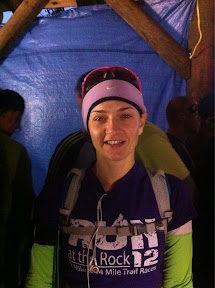
My friends Robin and Sarah were volunteering at the registration table and planned to run the 8 mile race the next morning.  It was great to see some friendly faces that night.  I got a big hug from both Kim and Jason Page (Bull City Running) when I arrived and shared a table for dinner with some new running friends.  Just before I left to head to my hotel, Robin and I snapped a quick picture.


I slept about 5 hours before the alarm went off.  It was COLD that morning...the temperature was around 18 or 19 degrees.  It's a bit tricky to know what to wear when you start a race at 19 degrees but know that it will be sunny and warm up to temps in the 40s.  I layered well, which helped.  But any way you slice it, 19 degrees is cold.

The photo below shows the bag drop off at the race start/finish.  It was also fairly dark when we began, although at the last moment before the race I ditched my headlamp and decided to just wing it for the first 15 or 20 minutes until the sun really started to come up.  This was a great decision; as it turns out, it was light enough.  I'd brought two headlamps with me...one for my drop bag at the turn around point and the one I had on until moments before the race began.  In the end, I would need neither.


I wore my compression running tights, a thin long sleeve running top with a short sleeve running top layered on top, my very thin cycling jacket (with sleeves that can be unzipped to create a vest), my ear warmer headband, and gloves.  I also had my 2-liter camelbak on my back for the duration of the race.


The first (and subsequently the last) mile of the 40 mile race is brutal: very rocky, very steep, and very unrunnable.  I wouldn't know how the front runners traversed this part of the course, since I stayed at the back of the pack the entire race, but I can't imagine they run this part easily.  After we climbed up, up, up, I had a beautiful view of the sun coming up through the trees.  It was worth pausing to catch the moment.


All of the aid station volunteers at this race were fantastic.  The 5 mile station guys were particularly awesome.  I was one of the last runners to come through, and they couldn't have been nicer to me.  It was a frigid, freezing cold morning, and they had nothing but smiles and words of encouragement.  They'd also posted the signs below for runners to read as they left the aid station.


As the early miles ticked by, I was feeling terrible.  I was sluggish, moving even more slowly than I would have expected, and I felt really emotional.  I kept tripping and stubbing my toes on rocks and overall just felt like this was not where I wanted to be.  To make matters worse, the flow line on my camelbak kept freezing.  Three times in the first few hours or so of the race, I had to work the line to break up the ice enough for the water to flow through.  As the 20 mile racers, who started well after the 40 milers, started to pass me, I became angry and tearful.  For each statement of encouragement that I received from the front-of-the-pack 20 milers, I had a rude retort that I shouted to them in my mind.  To sum it up, I was not myself.  At all.


Around mile 10 I started to go over in my mind what might be going on with me; I am pretty tenacious and stubborn in races, but I just could not imagine going 40 miles feeling the way I was feeling.  I started by taking inventory: eating and drinking enough.  I realized immediately that I wasn't doing either.  It was so cold that morning, and I definitely wasn't drinking enough.  I hadn't stopped to pee at all since the race began (NOT my usual).  It hit me that if I were drinking on a regular basis, the camelbak flow line wouldn't be freezing.  I couldn't recall how long it had been since I last ate something.  I forced myself to start drinking a little every few minutes to help battle the effects of what was probably some degree of dehydration, and I got on my typical schedule of eating every half hour.  Very slowly, I started to come around.  The difference between the fog of the first 10 miles and how I felt by the turn around point at mile 20 was stark.  I was simultaneously happy and embarrassed: happy that I'd figured out what the problem was but embarrassed that I'd made such a rookie mistake.

As I stopped to eat (and pee, finally) at the aid station around mile 14 or 15, my friend, Todd Zarzecki (husband of the fabulous Alyson Zarzecki), caught up to me.  He was running the 20 miler and was looking strong.  We left the aid station together and walked, talked, and ate for the next mile or so.  Todd took off to finish his race, and I told him I would look for him at my turn around.  Before I knew it, Todd was completely out of sight.  Speed racer.


When I did make it to the 20 mile turn around, I was still a little spacey and out of it but was feeling better.  I was handled by 3 aid station volunteers.  They brought me hot soup, helped me sort through my drop bag to figure out what I needed from it, and then gently but firmly told me I needed to head back out to meet all of the time cutoffs.  I was definitely on the time bubble.  Todd found me as I ate my soup and gave me some words of encouragement.  He also gave me a power bar which I ate on the way back (thanks again, Todd!).  As I started back towards the finish, I was tired but felt okay.


As the miles wore on, though, true fatigue really set in.  The descents were as bad as the ascents.  My quads and hamstrings were screaming, and I wasn't even moving very fast.  I kept one eye on the clock and simultaneously tried to relax and zen myself through the race.  It very quickly became obvious, though, that there was no way I would avoid finishing the race in the dark.  The thought of the steep, rocky descent of the last mile in the dark was not a welcoming thought.  I approached mile 32 exactly at its time cutoff of 5pm.  The sun was starting to go down, and it was even darker in the woods.  I was wearing a headlamp I picked up at the turn around but did not relish the idea of having to use it on the rough Uwharrie terrain.  I had only 8 miles to go but knew that given my current state of fatigue and physical pain combined with the fast approaching dark, it would likely take me longer than the total time allowed for the race.  Furthermore, I had to reach the mile 35 time cutoff in an hour (20 minute miles for the next 3 miles) and didn't think I could do it.  As I came up out of the woods at the aid station, I was met by a volunteer.  He asked me how I was doing, and I told him I thought I was done.  I also told him it would be an easier bitter pill to swallow if he told me he wouldn't allow me to go on because of the time, rather than my deciding to quit.  He smiled and told me I needed to stop.  I smiled back and thanked him.

The pictures below show me at the aid station at mile 32, my last stop of the day.  I was relieved to be done and bitterly disappointed not to have gone all the way to the end of the 40 miler. 


And I was deeply tired.  I couldn't wait to get hot food, a hot shower, and go to bed.  I headed back to the hotel and did just that.


In the month or so since this race, I've come to realize I generally do not drink enough when it's very cold outside.  It's a very conscious effort to force myself to do it, but it's obviously worth the effort.  When it's hot out, I drink a ton - even more than most of my friends doing the same activity.  In general, I'm a drinker, so to speak, with physical activity.  The importance of staying hydrated, even in very cold temperatures, cannot be overstated.

I've also come to realize that I was under-prepared for the terrain of Uwharrie.  The most difficult single track trails out at Umstead, where I trained for this race, are nothing at all like this trail at Uwharrie.  I was good for the distance but not the steep and rough terrain.  I will train differently the next time I attempt this race.

In the first week after the race, I felt extremely, bitterly disappointed that I did not finish it.  It never occurred to me prior to the race that I might not.  It was just a matter of how slowly I would go.  Not finishing made me feel embarrassed and inadequate, like I attempted something I shouldn't have attempted and then naturally failed at it.  Time after time in those first days after the race, well-intentioned friends kept telling me to be proud of how far I did go instead of focusing on not finishing, as if my disappointment was unwarranted.  The vast majority of these friends don't run very long distances, so running 32 miles seems nearly impossible to them.  But I think of it like this: had I set out to run 5 miles but only finished 3, I think more people would be able to understand my disappointment.  I found myself dismissing these friends' sentiments and words of encouragement, chalking them up to the fact that non-distance runners just don't understand.

And then I finally got over myself.  I realized that my friends, whether they run distance or not, were right.  How self involved of me to think otherwise.  I'd run 32 very difficult miles and called it when I knew I needed to stop.  For someone who pushes herself and her limits, calling it is a big deal.  I had given it a go, and at the end of the day it ended up being a difficult but great training run for the Umstead 100.

Several weeks later, I am forward focused on the huge effort I will put forth in 4 weeks when I race the Umstead 100.  Uwharrie is but a memory...until next February.


Monday, January 7, 2013

Neusiok Trail Run 43 Miler: My First Ultra


On Saturday, January 5, I embarked upon my first ultra marathon: the Neusiok Trail Run (NTR) 43 miler in Croatan National Forest in eastern North Carolina.  It was mostly a training run for the Umstead 100 miler I'm planning to run at the beginning of April, but it was also my first official ultra.  I couldn't help but be excited.

The race would be held on the Neusiok Trail in Croatan National Forest.  As per the US Department of Agriculture Forest Service website entry (http://www.fs.usda.gov/recarea/nfsnc/recreation/natureviewing/recarea/?recid=48466&actid=63):

"The Croatan National Forest's 160,000 acres have pine forests, saltwater estuaries, bogs and raised swamps called pocosins.  Bordered on three sides by tidal rivers and the Bogue Sound, the forest is defined by water."  The race website (http://www.neusioktrailrun.com/Welcome.html) had this to add to my very limited body of knowledge about this race:

"While running the Neusiok Trail you will cross black water cypress swamps, pine forest, pocosin’s and portions of the Neuse and Newport River. You will be crossing small creeks and swampy areas. The worst swampy areas such as “Cotton Mouth Spa” have foot bridges. You may encounter various bird species including Gulls, Quail, Hawks and Bald Eagles. The Croatan National Forest is also the natural home of the famed Venus Fly Trap. It thrives here because biting flies & insects keep them full.

While on the Neusiok you may encounter a variety of wildlife including White Tail deer, Black Bears, Raccoons, Fox, Otters, Squirrel, Alligator and 5 kinds of venomous snakes including Cotton Mouth, Copperhead and 3 types of rattlesnakes (Eastern Diamondback, Pygmy and Canebrake). While it’s unlikely you will encounter a snake the January you should still watch your step closely."

I drove out to Havelock on Friday afternoon, stopped by race registration to pick up my race stuff, and then checked into the hotel.

Suffice it to say I didn't get great sleep the night before the race, which is typical for me.  It ended up being about 6.5 very broken hours, filled with dreams of bears and sounds in the forest.  I was psyching myself out to be sure.  I woke feeling tired and plenty nervous about bears.  For those who don't know me well, I'm terrified of bears.  The mere mention of them in the race description was nearly enough to make me want to hibernate for the winter.  It was so unlike me to sign up for a race that might include them.  I did it anyway.  I'll admit I bought a bear bell at REI a few days before the race, but I ended up leaving it in the hotel room.


I wasn't exactly a minimalist for this race; I wanted to be sure I would have anything I might need at both the halfway point and at the end of the race.  Because the race director (RD) had informed racers that we could count on getting wet, I brought an extra pair of shoes and socks (among other things) to change into at the halfway/turn-around point.  The temperature at race start would be right around 32 degrees, and the day's high temp was supposed to be in the low 50's: a big enough differential to make dressing for the race a little complicated.  Layers were a must.


I ended up wearing my running tights, a long sleeve bottom layer shirt and short sleeve top layer shirt with an ear warmer headband and gloves.  I brought my sunglasses, thinking I would want them during the brightest part of the day, but they just got in the way.  I dropped them in my halfway point bag and changed my ear warmer to my favorite hat.

I was simultaneously excited and really nervous  prior to race start.


The morning was cold and very windy at the Pinecliff trail head near the water.  I was wishing I had on more but reminded myself of the heat furnace my body becomes once I start moving.  As it turned out, it didn't take long at all for the chill to leave my body.

The view from the start of the trail was really beautiful.  We got started just as the sun rose. 


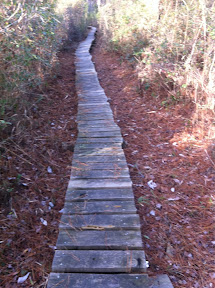
We were forewarned by the RD to exercise extreme caution on the several wooden footbridges we would encounter, like the one in the picture below.  He was not kidding.  In the freezing temperature, they all had a thin layer of frost on them, and they were super slick.  I walked very gingerly across each and every one of them, and I still slid around.  I saw one cocky runner bolt his way onto one only to completely lose his footing and land splayed out on the bridge.  Well, he was warned.  I love this picture because it gives a great idea of the feel of this swampy forest.  At times it felt very enclosed, and yet at others it was wide open.  I've never been any place like this.  I kept waiting for a black bear to jump out of the brush.  Or perhaps an alligator.  It was that kind of place.


As I began the race I felt okay.  I made a point not to start out too fast.  My race plan was to take it sort of easy at least through the first half and then see how I felt on the way back.  If I felt great I might push it, but at the end of the day it still was just a training run.  My only goal was to finish within the 12 hour time limit.  I thought I might be able to do it in more like 10 hours but would be happy with whatever I could do.

The 21.5 miles of trail are broken into a few sections.  From the northern most point, there are about 13 miles of solid trail made up of typical single track (pretty technical but not terribly hilly), wooden foot bridges traversing swampy bogs, and very flat pine needle covered trail (not very technical) surrounded on either side by brush and swamp foliage like in the picture above.  Throughout this initial 13 mile section, I began to question the intelligence of registering for this race.  The frost covered foot bridges were infinitely frustrating.  My pace going over them was so slow that my heart rate dropped enough for the chill to return to my body.  My fingers and toes were tingling from the cold.  I was shivering, and I was pissed.  The foot bridge that spanned 'Toad Wallow' was a half mile long.


That foot bridge felt like it would never end.  Wherever there was even the slightest bit of pitch in one direction or the other, I slid thanks to the frost.  Seriously, it was kind of ridiculous. 


I couldn't imagine 43 miles of this, and I really didn't want to do it.  To make matters worse, I'd successfully navigated the wet, swampy parts by skirting any water I encountered and essentially hugging and bushwhacking my way through the brush on either side of the trail.  To be clear, much of this brush included some type of bush with tall, thick, very thorny stems.  This brush was very dense.  By the end of the race my ankles were both pretty well scratched as well as my legs and arms from thorns grabbing onto me through my clothing.  But my luck (yes, luck) would only last so long.  Looking back, I'm not sure why I was so worried about getting wet other than the inherent potential discomfort associated with it.  Well, get wet I did.  It only took one misstep around mile 6, just over an hour or so into my race, and both feet, shoes, and socks, were soaked.  The first time is the worst.  I would remind myself of this multiple times throughout the day.

What I imagined this race to be and what it was turning out to be were two very different things.  Before the race I figured I could sort of crush 43 flat miles of trail.  Yet I'd been reduced to a snail's pace. 

Thankfully the foot bridges didn't last forever.  Before I knew it, I came to an aid station at the end of this first 13 mile section of trail.  I ate a little of the food they offered and tried to change my attitude.

The next two miles were on a gravel road that connects the northern and southern sections of trail.  This gravel road is the only time I wore my sunglasses.  I turned my iPod up and let the blaring music carry me across these two boring miles.  I passed a couple people, and a few others passed me.  It was otherwise uneventful.

After the gravel road I began the last section of the trail that would lead to Oyster Point, the turn around for the 43 milers.  I'd heard that the first few miles of this part would be 'boggy' but couldn't have anticipated the wet mess I would encounter.

The best way to describe the boggy section is to suggest imagining very enclosed trail covered in a thick layer of pine needles and huge 'puddles' (some up to about 30 feet long) that were bordered by dense brush.  I made a concerted effort not to plow through the middle of these 'puddles' but rather tiptoe my way around the edges, again hugging the brush.  Time consuming and a little futile.  I later heard that several of the puddles were as much as knee deep water.  Even going along the edges, I was ankle deep in water.

With just a few miles or so to go to Oyster Point, the bog subsided and the trail turned dry.  This was a lovely bit of trail: deliciously flat and not terribly technical.  As I neared the 43 mile turn-around at Oyster Point, I had a view again of water.  It was right around noon, and the day had become a typically beautiful NC day: bright, blue sky and warm winter sun.  I felt awesome.  I'd passed a few of the 21.5 mile racers and felt great about my prospects of finishing the second half.


The run back was, obviously, everything in reverse.  Because I knew that much water and soaked shoes awaited me on the return run, I made the decision not to change into dry socks and shoes at the turn around.  I would leave those for the end of the race, when I knew I would appreciate the dry warmth.  I could feel that a blister was starting to form on my right pinky toe but decided to leave that until the race end, too.  It was only going to get wetter.

This time, traversing the foot bridges was easier and faster.  The early morning frost was long gone, and they were dry.  I trotted across them all.  I took a moment to delight in the fact that I'd seen no cotton mouths anywhere near their spa.


In fact, I had seen no swampy forest critters all day long.  No bears. No alligators.  No snakes.  I knew they must be out there but was so very grateful that they'd made no appearance.  The trek back was much more solitary than the outbound leg.  I saw only a couple of other runners (until the end of my race when I saw all 10 or so of the 100k racers going back to Oyster Point) and a few hikers with dogs on the trail.  I'd listened to my iPod on the lowest volume all day long, but on this solitary leg back toward the finish, more than once I heard critter-like rustling in the brush.  Mostly it sounded like little rustling, but once I swear it sounded like the rustling only a very large animal (read: bear!) could make.  I was convinced I was about to become lunch.  I shut the iPod off, stopped dead in my tracks, and waited.  And then coughed to make some noise.  And waited a little longer.  And then felt silly and ridiculous, so I started to run again.  I sang out loud for a little while, and every so often I took a quick glance behind me.  There was never anything there.  Either a) I was being stalked by a predator, or b) I was psyching myself out.  I consciously decided I was just psyching myself out, and willed myself not to be scared.  It worked, sort of.

This time, I was so relieved to exit The Bog and hit the gravel road.  I trotted slowly down this road and enjoyed the change of terrain.  I knew that at the end of the road was a manned aid station (human contact...hooray!) and then only about 13 miles to the very end.  I got to the aid station, ate, ate, and ate some more, and then went on my way.  It was about 2:30p when I arrived there, so I still had four and a half hours to cover 13 miles.  I could walk it and finish in time.  Nice!

I didn't walk, though.  I ran, taking very brief walk breaks to eat and give my muscles a break, until darkness fell.  When I say ran, I mean that I trotted just a bit faster than a walk.  This was the most technical part of the trail, with roots, rocks, and leaves to camouflage it all.  I was tired and expected myself to fall (I never did).  I probably averaged around 13.5 mins/mile while running, and walking was more like 16 or 17 mins/mile.  Once the sun started to drop, though, I knew I needed to get as far as possible before full darkness fell.  I wasn't afraid to be on the trail in the dark.  I had picked up my headlamp at the turn around point and felt like I could handle anything that came my way.  But I was leery of running in the dark, upping my odds of a wipeout.  Around mile 40 fatigue started to creep into my legs.  I'd felt pretty good until that point, but dark and tired were a tough combination.

A sign pointed the way to the promised land. 


Full darkness came down upon me with about two miles to go.  I was bummed that those two miles took me about 45 minutes, eating away at precious time.  Even on a training run, I wanted to finish as fast as I could.  But logic reigned, and I was careful.

In addition to my speed, my body warmth was another casualty of the dark.  Because my heart rate had dropped so much, I again began to feel cold.  With the setting sun along came dropping temperatures.  And my feet were still wet and would get wet once more with about a mile to go.  By the very end of the race, I was shivering and dreaming of those dry socks and shoes.  Dry feet and hot food became my only motivation.  I was going to finish this race.

The very end of the trail was a little tricky to navigate.  It went from the forest out onto and across the sandy beach and then back into the forest to the trail head.  I was grateful for my powerful headlamp and sense of calm.

As I emerged from the forest, there was no fanfare.  There was simply a man, wearing his own headlamp, with a clipboard in hand to mark my finish and overall time.  It was simple, and it was perfect.

I made my way to the tent where my bags and hot food would await.  The RD and one other runner were the only two in the dark tent.  They congratulated me on my race, and the RD asked me what I needed.  I told him I needed my bags: my end of race bag and the halfway point bag (which held my dry socks and shoes) that was supposed to have been transported back to the start (the 43 mile finish).  The RD's face dropped, and he told me all the bags had been taken back down to Oyster Point for the 100k finishers.  But we weren't even done yet, I told him.  There was still one 43 miler on the trail.  He apologized and called to get our bags back to Pinecliff ASAP.  ASAP ended up being about 40 minutes later.  He then said that there wasn't really any hot food left but I could help myself to the cold snacks (the same candy and crackers that had been on the aid tables all day).  As I shivered visibly, I asked him whether there was any hot food left, at all.  He offered broth and ramen noodles.  I asked for ramen noodles, which were barely warm.  Huge bummer, but I took it.  He then led me to the ambulance, where I could wait and warm up.

I spent 45 minutes in the ambulance, chatting with the paramedic and getting warm.  By the time the bags arrived, I was mostly warmed back up.  The finisher awards were handmade bird houses, and I also received a screech owl house for being the first (and only) female to finish the 43 mile race.  Coolest finisher awards ever.

I drove back to the hotel completely happy to have completed this adventure totally on my own.  I signed up for it knowing no one else doing it.  I did it without any friends or family out there to support me, and I finished the course having gotten myself through some really low points throughout the day.  This race was all about me, and it was a huge success.  I felt like a huge success.  And I had become an ultra marathoner in the process.  Not a bad day.

Tuesday, January 1, 2013

Beach2Battleship

I'm typing this post on 01/01/13, more than 2 months after my second ironman race.  It's been on my list of things to do, but I kept putting it off.  I need to get it off my list of things to do, so I'm writing it now with a bit of a fuzzy memory and time/distance between now and the race .

Not long before the race, I decided to finally remove the Ironman Louisville race number from my bike.  It took me a year or so to do it, but when I was ready it was a cinch to do.


My sister, Stephanie, flew into North Carolina from Oklahoma on Wednesday before the race.  We hung out that night in Durham and got last minute things ready for the race.  Thursday afternoon we drove to Wilmington on the NC coast, about a 2.5 hour drive from Durham.  When we arrived we drove directly to The Oceanic for a fabulous lunch.  After we ate, we hung out on the beach, relaxing and taking in the gentle breeze and cool temps.  The view was unbeatable.


Steph spent some time combing the beach for seashells, or 'ocean rocks' as her little boys call them.  I found some, too.


Thursday evening, after we checked into the hotel, we walked through downtown Wilmington, where the race would finish.  We had a perfect view of the the battleship North Carolina across the water with a pretty sunset.


AND, we caught a glimpse of a rainbow, surely a sign of good luck for me in my race.


We capped off the evening with a carriage ride through residential historic Wilmington.  It was a great way to relax before the craziness of the race began.


Friday morning entailed a quick bike ride, quick run along the water, and then packet and bag pickup.  Time to get things started!  We ran into my friend, Craig, at packet pickup.  Craig was one of several friends I knew doing the half ironman on Saturday.  The three of us walked to lunch at Paddy's Hollow.


As we ate lunch, I began to feel the stress and time pressure of the next day's race looming over me.  Steph and I went back to the hotel room, and I began the task of filling my gear bags and organizing and then reorganizing my gear.  I panicked at one point when I miscounted the power bars I brought for the bike ride.  I always bring extra, and somehow it looked like I was going to run out of power bars on the bike.  What happened?  How did I screw that up?  As it turned out, I didn't screw up.  I just wasn't counting them correctly.  I brought enough and then some with me, which would later prove to be fortuitous.  Time to calm down and get things right.


I'm accustomed to all the gear I use when I train (i.e., all the nutrition, laundry, water bottles, shoes) but am always impressed when I lay out all the gear for an ironman race.  It's a lot of stuff!


Once I laid out all the gear on my bed, I filled the race bags.  This is always the most stressful part of my pre-race routine.  I don't want to forget anything crucial to the race, like...my bike shoes.  This is also the most time consuming part - laying out all the gear and then filling the bags.  But once it's done, it's done.  Then it's time to relax.


Steph thought I should get a picture of my wetsuit.  Unlike Louisville, this race would be wetsuit mandatory.  A late October swim in the intra-coastal waterway is usually cold.  This year it was quite a bit warmer than usual, but I was happy to have the wetsuit.


Here I am dropping off my bike and gear bags at T1 the evening before the race. 


I'm always so happy to get the gear dropped off.  I don't like to leave my bike overnight, but it's required.  And once it's out of my hands, there is nothing I can do but relax and try to get some rest.  It's always a load off the mind.

I was so grateful to have my little sister at the race as my crew and support.  It would be a long day for both of us, and it was great knowing she would be cheering for me and collecting my bike and gear as I began the marathon...one less thing we would have to do after the race.  Thanks, Stephanie!


The night before the race I slept relatively well.  I typically have a lot of difficulty resting through the 2-3 weeks of taper before an ironman race.  I did better this year than last year with Louisville, but the night before is always a challenge.  I ended up getting around 5 or 6 broken hours of sleep, which felt pretty good.  I woke with the early alarm and was ready to race.  In the weeks leading up to the race, I was calm and (as one friend put it) underwhelmed.  This feeling would persist straight through to race morning.  I woke and felt excited but very calm.  I'd been through all this the year before, and I knew what I needed to do to get through the race.  My first goal was to finish, my second goal was to break 16 hours.  With an easier course and cooler temps, both goals seemed attainable.  Don't get me wrong...an ironman race is an ironman race, a formidable challenge at best.  Even with a wetsuit, saltwater swim that ran with the current, a flat bike course, and flat marathon, 140.6 miles is a really long, tiring way to go.  But if ever I would be able to beat my IM Louisville time of 16:15, this would be the race to do that.

Race morning I was all sleepy smiles as I prepared to air up my bike tires and drop my nutrition and water bottles at my bike.


After I dropped my stuff at my bike, I found the line for the shuttle bus that would take me to the swim start.  It was a point to point swim through the intra-coastal waterway, with swim exit basically right across the street from T1 at a marina.  After I got to the swim start, I found my friend Adam, who was also racing the full ironman distance.  We'd trained some together at the downtown Durham Y, and it was the second go for both of us at the ironman distance.  As calm as I was, Adam was fairly amped up.  He was hoping to break 12 hours for a fast race (he ended up with a finish time of 12:05).  It was great to see a friendly face.  Spectators were discouraged from going to the swim start, so I told Steph just to wait for me at T1, where she could see me run from the marina to the transition area and then, after I changed into my bike gear, begin on the bike route.  I also saw my friends, Rod and Angie, who were attempting their first ironman race.  The three of us had done a training bike ride together and kept up with each others' training progress.  The bonus of doing a local race like this is knowing many people who would be on the course.

I did a quick practice swim, and before I knew it the time had come to start this race.  The water felt great, and I was hopeful for a good swim.  My swim was fabulous.  I never felt anxious or nervous.  In fact, I was uncharacteristically very calm.  I began my swim and felt great.  It was a mass start, and there was the usual vying for water territory.  I got kicked, elbowed, and swum over, but I was expecting it and didn't get rattled.  At all.  I emphasize this, because it is so unlike me.  Having some experience with the iron distance under my belt really helped.

I'd heard that the current could be very strong, so many folks were expecting a fast swim.  As for me, I knew I would be happy with a swim time close to my Louisville time, which was just under 1:30.  With an excellent current I figured I could potentially finish the swim in 1:15 but wasn't striving for anything more than to get through the swim.  At one point, I tried to gauge my pace against one of the paddle boarders who was staying relatively still.  He was probably about 50 yards from me, and as I passed him I didn't feel like I was going particularly fast.  No big deal.  I would finish when I finished and then get on with the rest of my race.

I had an energy gel tucked into my wetsuit sleeve, and I took it around the 45 minute mark, what I expected to be about halfway through my swim.  Most triathletes I know don't take a gel during the swim, but I have found that it helps to keep my energy levels high and steady.  So I rolled over on my back and gently kicked and floated for about twenty seconds while I swallowed the gel.  It gave me a quick view of who was around me, and I was pretty happy to realize I was nowhere near the last swimmer in our pack.  I would later find out from friends who raced the half ironman course that as we full distance racers swam past them as they waited to start their race, we were flying.

When I rounded the last turn buoy I got an idea of my pace.  I've never passed a buoy that quickly.  In the world of endurance triathletes, I'm generally considered a slow swimmer.  I wasn't that day, thanks to a fantastic current, saltwater, and a wetsuit.  Soon after the last turn buoy, the wiggly man signaling the swim end came into my view.  Holy cow!  I was close to the finish line.  This seemed to be a great swim for me.

As it turns out, it was an unbelievable 2.4 mile swim for me.  I exited the water with a swim time of 1:03:37.  Just over an hour?!  Yes!  I was ecstatic and feeling great.  I still marvel about that swim.  It was perfect.

As I ran across the street from the marina to T1, I saw Steph and yelled to her about my great swim time.  She just laughed and snapped a quick shot of me running with wetsuit in hand.


My transition times are never fast, and this race was no exception.  My T1 time between my swim and bike was 13:07.  Considering I had to get dried off, changed, and ready to bike, I wasn't disappointed with this time.

I ran my bike through the transition area and to the mount line.  As soon as I hopped on to start pedaling, I realized my chain had come off.  Still fully calm and relaxed, I found the curb to get out of the way of the rest of the pack hitting the road.  A spectator offered help, but I was a pro by this point at popping my chain back on.  I did so and jumped back on the bike for an afternoon of biking.  112 miles, here I come!


For the most part, the bike ride was good.  There was a formidable headwind for most of the ride, but I knew to expect this out near the coast.  That was the trade-off for no hills: a flat, "fast" course with ocean headwinds.  For the first 30 miles or so, the half ironman bike course ran right along with the full ironman course.  So the fastest half iron athletes caught up to those of us who are slower cyclists.  To be totally honest, most of these folks were men who were probably in their 30's or so and are bad ass triathletes.  Some of them had an attitude, cutting in and out and all around us slow, full racers.  One or two were real jackasses, who clearly thought they were special and were going to let us all know it.  And then some of them were just regular folks who passed with a word of encouragement for those of us whose race day would last well beyond their own.  They had an idea what we were going through, and it was great to hear their words of encouragement.

After the half ironman cyclists turned off our course to head back to town, it was time to get down to work.  With 80+ miles ahead of me, it was going to be a long afternoon.

I was on spot with my nutrition throughout the bike.  I did find myself needing to pee (I was well hydrated) as soon as I got on the bike but had decided to wait as long as I could.  When I finally pulled off the road at one of the aid stations early on, there was a long line at the porta-john.  I didn't want to wait, so I hoofed it into the nearby woods and took care of business.  Unbeknownst to me at the time, as I ran to the woods some of my power bars popped out of the back pocket of my jersey.  It was a few hours later that I realized they were gone.  Thank goodness I had brought extras and stashed them in my bike special needs bag that I would have access to at the midway point on the bike course.  It was a rookie mistake, but I had planned well for such events.

Overall I had a good, solid bike ride with a total time of 7:08:54.  The overarching impression was that this was a much more solitary, more desolate bike course than what I experienced the year before in Louisville.  First, it was a much smaller race, with only about 650 or 700 people registered for the full ironman distance (versus something like 2800 or 3000 racers at IM Louisville).  B2B's bike course was one large loop, instead of two, so there was less opportunity for spectators to see their racers out on the course.  I never felt lonely or very bored, but I was looking forward to getting off the bike and seeing some friends and my sister along the marathon course.  In Louisville, I saw my family waiting for me around mile 35 and then again around mile 70 on the bike, and it was a big boost to me.  During this race, it was right about mile 70 when I realized I wasn't seeing anyone at all, including other racers, let alone any spectators or family.  And then...up the road...I saw a truck pulled over with some yahoo leaning up against it, hollering to me.  Well, beggars can't be choosers, and I would take the encouragement.  But as I drew closer to him, he was yelling at me like he knew me.  And then I realized he did know me.  Brent Dorenkamp!  Brent and I had done some training rides together during the summer and early fall, and it was awesome to see him out in the middle of NC nowhere.  In the middle of nowhere, I had a one man cheering section, and it was exactly what I needed at that moment in time.  I rode past him with a smile and a hello, and then just down the road he pulled up beside me in his truck, took a quick picture with his cell phone, and then drove away with more words of encouragement.  It's amazing how the smallest little act of kindness and encouragement can make such a huge difference in a race like this.  Thanks, Brent!  It was great to see you out there.


My bike ride went on, and as I drew closer to Wilmington I became more and more excited to start the marathon.  All was going well.  Then right around mile 100, my stomach flip flopped and began to cramp up.  Ugh.  I'm accustomed to GI issues on the marathon or long distance runs, but generally on the bike my stomach behaves.  Not so much today.  I tried to figure out what might have caused the upset, and the only thing I came up with was the cheez-its I downed from my special needs bag.  Even that didn't make a lot of sense, though, because on plenty of training rides I ate cheez-its, a favorite training indulgence.  In the end, it didn't really matter what caused the upset, aside from trying to avoid it in the future.  What mattered was that I was now faced with running an entire marathon while in GI distress.

I tried to use the bathroom as I transitioned from the bike to the run but had no luck.  My T2 time ended up being 14:20, slower than T1.  That was a bummer, but it was okay.

As I began the run, my stomach was completely cramped up.  It was extremely painful, and I wasn't sure how I might manage getting through 26.2 miles of it.  I was nauseous and really wanted to throw up but was unable to do so.  I kept thinking, 5-6 hours of this won't be possible.  I really thought that, after an amazing swim and solid bike ride, I was going to have to give up my race because of GI distress on the marathon.  For the first 10 miles or so this was my mental state: I can't run an entire marathon like this...it's painful and I want to stop.  I can't do this.  I can't take hours of this pain.  And then it occurred to me that if I kept thinking I couldn't do it, then I really couldn't do it.  But I'm stubborn and very determined.  I told myself to focus on finishing the race.  Forget about breaking 16 hours, just keep putting one foot in front of the other, and finish the race.  I also reminded myself to break down the marathon into smaller parts.  Imagining running 26.2 miles at that point for anyone is a daunting task.  So I started to focus on getting through the next mile.  One mile at a time, that's how I was going to finish this thing.  One mile at a time.  That's how I ended up doing it.


Steph caught a couple pictures of me when I was just starting the marathon, a few miles in.  I hollered to her that I was completely sick to my stomach and didn't know how I could finish.  She gave me words of encouragement, and I kept at it.  It was so good to see her.  I hadn't seen her since I started the bike ride many hours before, and it was great to see her pretty smiling face. 


The marathon course was a loop that runners did twice.  As such, I was able to see my friend Adam a few times along the run course.  He told me he'd had an awesome bike ride (less than 6 hours) but was sort of paying for it on the run.  He was struggling too, but we both kept at it.  I saw many spectator friends as well as my sister along the run course, and their cheers also helped to keep me going.  And right around mile 24.5 or 25 of the marathon, my friend Dennis Geiser who was spectating that day came toward me in the dark and started walking with me.  I think he and my sister had begun to wonder where I was, so he decided to do a little course recon.  I told him how sick I'd been and continued to feel, and he walked and talked with me.  When I felt like running, Dennis ran with me, with his backpack on his back.  He told me stories and kept me going.  He encouraged me to just keep putting one foot in front of the other.  And when the finish line was within sight, I thanked Dennis and took off at as much of a sprint as I could muster.

The most I can say about my marathon is that I finished it.  It was very difficult and the slowest marathon I've ever run (6:23:45), and my stomach remain cramped up and tender for the duration.  I think I am most proud of this piece of the whole race, because I found myself up against tough odds and I persevered.  I am so proud that I pushed through.  There is an aspect of ironman training and racing that is hard to put into words but is absolutely essential to success.  As much as an athlete needs to be physically and nutritionally prepared for the rigors of this type of endurance race, she also needs to have solid mental fortitude and toughness.  She has to want it.  Badly.  It would have been so easy for me to quit the race when that awful stomach pain hit.  It's really tough to run through that.  But instead, I dug down and found something deeper inside me that wanted that finish more than I wanted to give into the pain and quit. That desire pushed me to keep going to the finish line.

As I came across the finish line, I was encircled by my sister, friends Eleanor and Stephanie who had raced the half ironman that day, and a couple of their friends.  There were hugs and smiles all around.  I was given my finisher's medal and a heat blanket as well as my recovery drink that my sister insisted (as per my earlier instruction, THANKS, Steph!) I drink.  I tried to eat a little but was still too sick to my stomach to take much in.  More than anything, I was elated to be done with the race and was thrilled with my overall finish time of 15:03:40.  I'd wanted to break 16 hours and nearly broke 15 hours!  For a brief moment my mind went to the what-if place of what if my marathon time had been better...I could have broken 15 hours.  But that thought was fleeting, and I reveled in the fact that I'd had such an awesome race.  It was a great day all around.  That marathon proved to be so tough, but I did it.  I did it!  It felt great to solidify my accomplishment as an ironman for a second time.


Training for this race was very different than training for IM Louisville the year before.  Before Louisville I did a lot of my training with Wes, and I felt like he was an integral part of my success that race day, like I couldn't have done it without him.  This year, I did much of my training alone or with various friends but had to rely on myself to get out of bed every morning to hit the Y before work or get my butt to training rides and runs.  It was a veritable test in commitment to the goal, and I learned that I could do it on my own.  Having said that, I am so grateful that my sister accompanied me to Wilmington to be a part of my race experience.  She was a great support system for me there, and I wouldn't have wanted to do it without her.  If I ever decide to take on this race again to break that 15 hour mark, she will be at the top of the list of people I ask to come with me.  Love you, Steph!


The morning after the race, I awoke to some stiffness and soreness but found that I felt much better than I did after IM Louisville.  Steph and I had a huge breakfast in the hotel and then did a little shopping in Wilmington before we drove back to Durham.  The battleship was in all its beautiful glory and is a great icon for this race.


Here's to what ended up being a great 2012 racing season and a fantastic second ironman race for me in the midst of some of the most difficult personal turmoil I've experienced.  I'm looking forward to 2013, my foray into the ultra marathon world, and all the new beginnings that the new year will hold for me.

Sunday, December 9, 2012

Beyond the Marathon

Saturday I ran 27 miles on the bike and bridle trails out at Umstead as my long run.  I'd thought I would run that distance a couple weeks before (the weekend of Thanksgiving) when I ended up having a terrible long run of only 13 miles.  I was exhausted that entire run a couple weeks ago, so I decided not to push it and called the run at 13.  I was bitterly disappointed but figured disappointment was better than injury.

Last weekend I ran the Run at the Rock in Cedarock Park in Burlington, NC.  It's a great race that I had done a few times before.  You can do a 7-mile single track loop once or twice.  This year I opted for twice and had a fabulous 14 miler.  I also had a spectacular, superman sprawl fall on the second loop.  Thankfully the only thing I injured was my ego.  I was a little banged up and bruised, but all in all I came out of that fall unscathed.  I need to be very careful on single track.  I tend to fall.

So this past Saturday's long run of 27 miles had me on Cloud 9.  That is the farthest I've ever run.  The fun thing about training for ultras is setting PR distances just with training.   I'm hoping to repeat that mileage again this next coming weekend.

I'm currently nursing a sore right forefoot.  I first thought it might be a stress fracture but have since decided it must be a Morton's Neuroma.  What I need to do is have it looked at by a doctor, since I am not one.  In the meantime, though, I've put a Dr. Scholl's forefoot gel cushion on my insole and have been enjoying much less pain when I run in my road shoes.  My Montrail trail shoes are another story.  They are thinner, lighter, and provide much more information about what my feet are landing on than my road shoes do.  Right now, the cumulative effect of that goodness is that my feet hurt like hell when I run in them, even with a gel cushion.  So I'm going to stop running in them.  I can easily feel comfortable in my road shoes on the bike and bridle trails at Umstead.  As for single track, well, I think my trusty Brooks road shoes will have to do there as well.  I'm worried about falling in road shoes on single track even more than I would otherwise, but I can't plan to run dozens and dozens of miles with the foot pain I've been enduring.  I'm going to experiment a little and keep track of what works and what does not.

Also new for me this weekend was eating Stinger waffles on my long run.  I have been starting with Carb-Boom gels and then working my way into more solid stuff.  This run I ate gels, Stinger waffles (so delicious...I highly recommend them and in fact went into Bull City Running this afternoon and bought three boxes of them), dried cherries, and goldfish.  My only liquid was water.  My stomach cramping was kept to a minimum, which was a huge relief.

This week I'm hoping for two runs of 10-12 miles each and a speed work run that will be anywhere from 5-7 miles.  Maybe I'll try to add that speed walking workout that I've dropped back into my week.

It's fun to know I've run beyond the marathon distance at this point.  I hope to go much, much farther but regardless of what the future holds, no one can take away what I've already done.  I've gone beyond the marathon.